

Table of Contents
Choosing between a diploma and a degree is one of the most important decisions for students planning to study in Singapore. Both qualifications offer valuable opportunities, but the right choice depends on your academic background, career goals, budget, and preferred learning style.
Singapore is globally recognised for its high-quality education system, offering internationally respected diploma and degree programmes that prepare students for successful careers across various industries.
This guide compares diploma and degree programmes in Singapore to help you make an informed decision.
Understanding Diploma and Degree Programmes
Before making your decision, it’s important to understand the difference between these two qualifications.
What is a Diploma?
A diploma is a career-focused qualification that provides practical knowledge, technical skills, and industry exposure. Diploma programmes prepare students for employment while also offering pathways to higher education.
Diploma courses are ideal for students who want to enter the workforce quickly or continue towards advanced studies later.
What is a Degree?
A degree is a higher academic qualification that provides in-depth theoretical knowledge, research skills, and specialised expertise in a chosen field.
Degree programmes are often required for careers in engineering, law, medicine, research, and senior management positions.
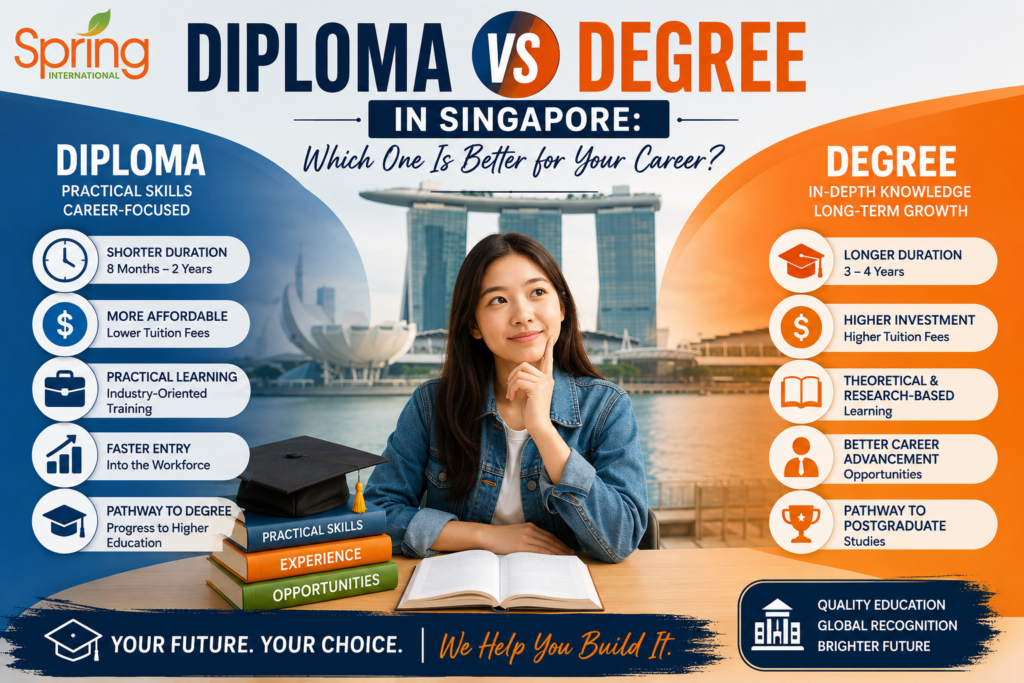
Diploma vs Degree: Key Differences
Feature | Diploma | Degree |
Duration | 8 months to 2 years | 3 to 4 years |
Learning Style | Practical & industry-focused | Academic & theoretical |
Cost | More affordable | Higher tuition fees |
Career Entry | Faster | Longer preparation |
Practical Training | High | Moderate |
Research | Limited | Extensive |
Further Study | Can progress to degree | Can pursue postgraduate studies |
Best For | Skill development | Professional specialisation |
Benefits of Studying a Diploma in Singapore
Many international students choose diploma programmes because they offer an excellent balance between education, affordability, and career opportunities.
Practical Learning
Diploma programmes focus on real-world applications rather than purely theoretical knowledge.
Faster Graduation
Students can complete their studies sooner and begin building their careers.
Affordable Tuition
Diploma programmes generally cost less than full degree programmes, making them attractive for international students.
Industry-Relevant Skills
Students develop practical skills that employers actively seek.
Pathway to a Degree
Many students complete a diploma before progressing to degree-level education.
Benefits of Studying a Degree in Singapore
A degree remains an excellent investment for students seeking advanced professional careers.
Comprehensive Knowledge
Degree programmes provide deeper understanding of specialised subjects.
Better Long-Term Career Growth
Certain professions require bachelor’s degrees as minimum qualifications.
Higher Education Opportunities
A degree allows students to pursue master’s and doctoral programmes.
Research Skills
Students develop analytical and critical thinking abilities through research projects.
Which Option Costs Less?
One of the biggest considerations for international students is education costs.
Generally:
- Diploma programmes have lower tuition fees.
- Degree programmes require a larger financial investment.
- Living expenses remain similar for both options.
Students should also consider the overall return on investment, including employment opportunities after graduation.
Which Qualification Helps You Find a Job Faster?
If your goal is to start working as soon as possible, a diploma may be the better choice.
Diploma graduates often find opportunities in areas such as:
- Hospitality
- Logistics
- Business Administration
- Marketing
- Tourism
- Retail Management
- Customer Service
- Supply Chain
Degree graduates may have access to broader career opportunities, especially in specialised industries requiring advanced qualifications.
Popular Diploma Courses in Singapore
International students frequently choose diploma programmes in:
- Hospitality Management
- Business Management
- Logistics & Supply Chain Management
- Accountancy
- Marketing
- Tourism
- Information Technology
- Professional Chinese Teaching
These programmes are designed to provide practical knowledge and industry-relevant skills.
Popular Degree Programmes in Singapore
Common degree options include:
- Engineering
- Computer Science
- Business Administration
- Finance
- Nursing
- Architecture
- Law
- Psychology
- Data Science
These programmes are suitable for students seeking specialised professional careers.
Who Should Choose a Diploma?
A diploma may be the right choice if you:
- Want practical skills.
- Prefer hands-on learning.
- Have a limited study budget.
- Want to enter the workforce sooner.
- Plan to continue towards a degree later.
Who Should Choose a Degree?
A degree may be more suitable if you:
- Want advanced academic knowledge.
- Plan to pursue postgraduate studies.
- Need a bachelor’s degree for your desired profession.
- Prefer research-based learning.
- Are willing to invest more time in education.
Can You Study a Degree After a Diploma?
Yes.
Many students begin with a diploma before progressing to a bachelor’s degree.
This pathway allows students to:
- Gain practical experience.
- Build academic confidence.
- Reduce initial education costs.
- Make better-informed career decisions.
Why Study at Spring College International?
Spring College International offers industry-focused diploma programmes designed to prepare students for successful careers and further education.
Students benefit from:
- Experienced lecturers
- Practical learning environment
- International student support
- Modern campus facilities
- Career-oriented curriculum
- Globally recognised qualifications
- Diverse student community
Whether you want to begin your career quickly or continue towards higher education, Spring College International provides flexible study pathways that support your long-term goals.
Frequently Asked Questions
Is a diploma better than a degree?
Can I get a job after completing a diploma?
Can I study a degree after finishing my diploma?
Is a diploma cheaper than a degree?
Which qualification is best for international students?
Final Thoughts
Choosing between a diploma and a degree in Singapore depends on your personal ambitions and career plans. A diploma provides practical skills, shorter study duration, and quicker entry into the workforce, while a degree offers deeper academic knowledge and broader long-term career opportunities.
If you’re looking for career-focused education with internationally recognised qualifications, Spring College International offers diploma programmes that prepare students for success in today’s competitive global job market.