
Completing the GCE O-Level is an important academic milestone. For many students, it is also the point where they begin making decisions about their future education and career.
But what can you actually study after O-Level in Singapore?
There are several pathways, and the best option depends on your academic results, interests, preferred learning style and long-term career goals.
Students can consider routes such as Junior College, Millennia Institute, Polytechnic, ITE, arts institutions and private education pathways. International students may also consider international qualifications and private diploma programmes depending on their eligibility.
Singapore’s Ministry of Education (MOE) identifies Junior Colleges/Millennia Institute, Polytechnics, ITE and Arts Institutions among the post-secondary pathways available after O-Level.
What Is the O-Level?
The Singapore-Cambridge GCE O-Level is a secondary-level qualification jointly administered by the Singapore Examinations and Assessment Board (SEAB), Singapore’s Ministry of Education and Cambridge Assessment International Education.
It can provide a pathway to post-secondary education in Singapore and is also recognised internationally.
Spring College International’s O-Level programme explains that the qualification can be used for progression to Junior Colleges, Polytechnics and private institutions, depending on the student’s qualifications and admission requirements.
For international students, completing an O-Level can therefore open several possible education routes.
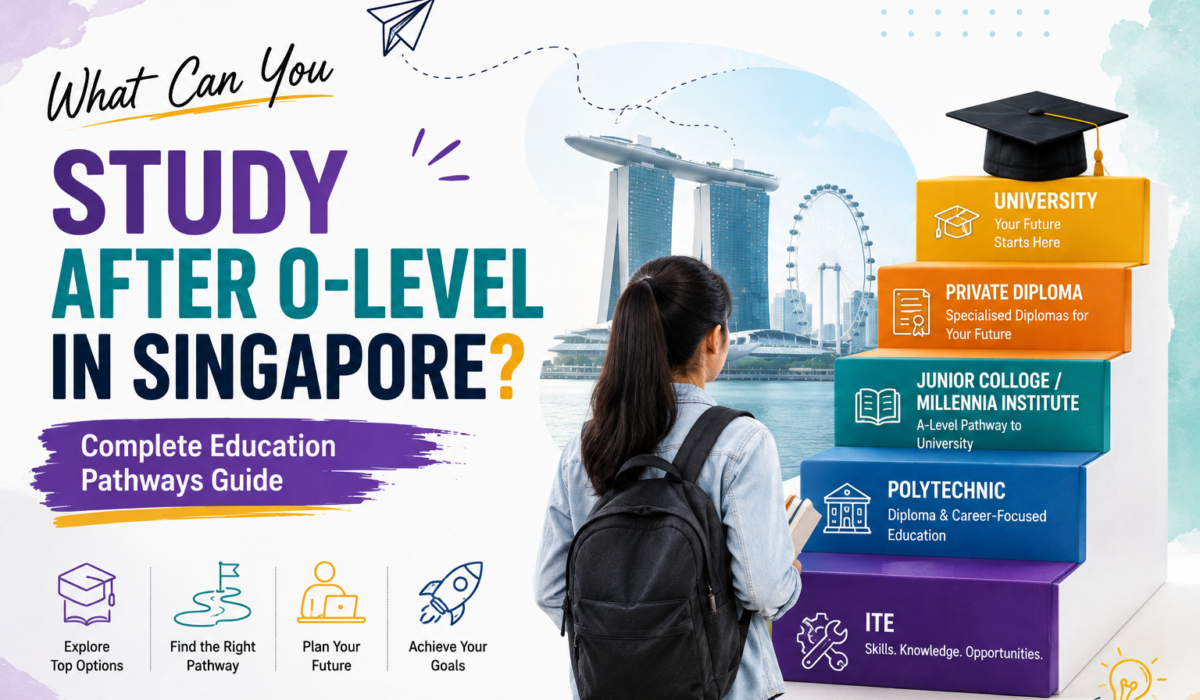
What Are the Main Options After O-Level?
After completing O-Level, students can consider:
- Junior College (JC)
- Millennia Institute (MI)
- Polytechnic
- Institute of Technical Education (ITE)
- Arts Institutions
- Private Diploma Programmes
- International Education Pathways
Each option has a different purpose and learning approach.
Let’s look at them in detail.
1. Junior College (JC)
If your goal is to progress towards university and you prefer an academically focused environment, Junior College can be an option.
Junior Colleges generally provide a 2-year pre-university programme leading towards the Singapore-Cambridge GCE A-Level examination.
Who Is JC Suitable For?
JC may suit students who:
- Enjoy academic subjects
- Want a traditional pre-university pathway
- Are considering university education
- Prefer theoretical and academic learning
- Have strong O-Level results
After completing JC and the relevant A-Level requirements, students can apply for university programmes subject to the admission criteria of the university and course.
2. Millennia Institute (MI)
Another pre-university pathway is Millennia Institute.
Unlike the typical two-year JC pathway, MI provides a 3-year programme leading to the GCE A-Level examination.
This can be suitable for students who prefer a longer pre-university pathway before moving into higher education.
Why Consider MI?
Students may choose MI if they:
- Want an A-Level pathway
- Prefer a three-year pre-university programme
- Plan to continue to university
- Want additional time to develop academically
The choice between JC and MI depends on the student’s academic profile and preferred learning environment.
3. Polytechnic
A Polytechnic diploma is one of the most popular options for students who want practical, career-oriented education after O-Level.
Singapore has five local polytechnics:
- Nanyang Polytechnic
- Ngee Ann Polytechnic
- Republic Polytechnic
- Singapore Polytechnic
- Temasek Polytechnic
MOE states that Polytechnic graduates receive a diploma in their area of specialisation and can subsequently progress to university, arts institutions or the workforce.
Why Choose Polytechnic?
Polytechnic may be suitable if you:
- Prefer practical learning
- Want to specialise in a particular field
- Want industry-focused education
- Are interested in entering the workforce after graduation
- May want to progress to university later
Popular areas include:
- Business
- Engineering
- Information Technology
- Design
- Health Sciences
- Media
- Hospitality
- Applied Sciences
4. Institute of Technical Education (ITE)
The Institute of Technical Education (ITE) provides career and technical education for secondary school graduates.
ITE offers programmes including:
- Nitec
- Higher Nitec
- Technical Diplomas
- Work-Study Diplomas
MOE states that by academic year 2026, all Nitec courses will have transitioned to the enhanced three-year Higher Nitec structure, directly leading to Higher Nitec certification.
Who Should Consider ITE?
ITE can be a good option for students who prefer:
- Hands-on learning
- Technical education
- Practical skills
- Industry exposure
- Career-focused training
Students can also progress to higher qualifications after completing their ITE studies, depending on the relevant pathway and requirements.
5. Arts Institutions
Students interested in creative careers can explore Singapore’s arts institutions.
MOE’s post-O-Level pathway information includes institutions such as:
- LASALLE College of the Arts
- Nanyang Academy of Fine Arts (NAFA)
These pathways can be relevant for students interested in areas such as:
- Fine Arts
- Design
- Media
- Performing Arts
- Fashion
- Creative industries
The right programme depends on the student’s portfolio, academic background and the admission requirements of the institution.
6. Private Diploma Courses
Another option after O-Level is to explore private education institutions offering diploma programmes.
This can be particularly relevant for students who want a more direct, career-focused route into areas such as business, marketing, accountancy, hospitality or logistics.
Spring College International currently offers diploma programmes including:
- International Business Management
- Marketing
- Accountancy
- Hospitality & Tourism Management
- Logistics & Operations Management
- Logistics & Supply Chain Management
- Professional Chinese Teaching
The college states that its general diploma entry requirements include being at least 16 years old and having at least 10 years of formal education or passing the applicable placement test, together with the required English proficiency.
This means students should check the specific entry requirements of the diploma programme, rather than assuming that every private diploma has exactly the same requirements.
7. International Education Pathways
International students who have completed O-Level or an equivalent qualification may also consider an international education pathway.
At Spring College International, the International High School follows a Cambridge pathway through:
Grade 10 → Cambridge IGCSE → Grade 11 → Cambridge A-Level → Grade 12 → Cambridge A-Level
The programme is designed as a three-year progression, although students may enter at a later grade depending on their previous qualification.
The college states that students who have already completed IGCSE, O-Level or an equivalent secondary qualification may be considered for entry into Grade 11, subject to the programme’s requirements.
This can be an option for students who want to follow an internationally recognised Cambridge pathway before university.
Which Pathway Is Best After O-Level?
There is no single best pathway for every student.
Your decision should depend on what you want to achieve next.
Your Goal | Possible Pathway |
Prepare for university academically | JC / MI |
Gain a practical diploma | Polytechnic |
Develop technical skills | ITE |
Pursue creative studies | Arts Institutions |
Start career-focused private education | Private Diploma |
Follow an international Cambridge pathway | International High School / A-Level |
The most important factor is choosing a pathway that matches your strengths, interests and future plans.
Diploma vs JC After O-Level
One of the most common decisions students face is whether to choose a diploma pathway or continue with a pre-university route.
Choose JC/MI If:
- You are aiming for university.
- You enjoy academic learning.
- You want an A-Level pathway.
- You prefer broader academic preparation before university.
Consider a Diploma If:
- You prefer practical learning.
- You already have an idea of your career field.
- You want industry-focused education.
- You want to develop specialised skills.
- You may want to enter employment after completing your qualification.
Neither pathway is automatically better. Your decision should be based on your intended career and preferred learning style.
Can You Study a Diploma After O-Level?
Yes, depending on the institution and programme requirements.
At Spring College International, applicants for diploma programmes generally need to be 16 years old or above and have at least 10 years of formal education or equivalent, or meet the applicable alternative assessment requirements. English proficiency requirements also apply.
This makes private diploma programmes a potential option for students who want to move into career-focused higher education after secondary-level studies.
What Diploma Courses Can You Study After O-Level?
The right diploma depends on your interests.
Business
International Business Management can be suitable for students interested in management, marketing, business operations and entrepreneurship.
Marketing
A Marketing Diploma can prepare students for areas such as marketing, communications and digital business.
Accountancy
Students interested in finance and accounting can consider an Accountancy Diploma.
Hospitality & Tourism
Students interested in hotels, tourism, food and beverage and customer service can consider Hospitality & Tourism Management.
Logistics
Students interested in transportation, procurement, warehousing and supply chains can explore Logistics & Operations Management or Logistics & Supply Chain Management.
Spring College International currently lists these diploma areas among its available programmes.
What If Your O-Level Results Are Not Strong?
A lower result does not necessarily mean that your education journey has ended.
Depending on your circumstances, you may be able to consider different pathways, such as:
- ITE
- Private education
- Preparatory programmes
- Alternative academic qualifications
- International education pathways
Admission requirements differ significantly between institutions, so students should check the specific requirements before applying.
For example, Spring College International’s diploma programmes use a general requirement of 10 years of formal education or a placement test, rather than requiring a specific O-Level aggregate for every diploma.
What If You Are an International Student?
International students have additional considerations when choosing a pathway.
These include:
- Academic eligibility
- English-language proficiency
- Course requirements
- Institution eligibility
- Immigration requirements
- Student’s Pass requirements
For foreign students accepted into eligible full-time courses, ICA states that a Student’s Pass is generally required, unless the student already holds an applicable immigration pass such as a Dependant’s Pass, Long-Term Visit Pass or Immigration Exemption Order.
For private education institutions, ICA states that only EduTrust-certified PEIs can offer placements to foreign students who require a Student’s Pass.
Can International Students Study at Spring College International After O-Level?
Yes, eligible international students can apply for suitable full-time programmes at Spring College International.
The college currently offers:
- O-Level preparation
- International High School
- Diploma programmes
- Advanced Diploma programmes
- English programmes
- IELTS preparation
- Other education pathways
Its application page lists full-time options across preparatory, International High School and diploma programmes.
For eligible full-time programmes, Spring College International states that it can assist international students with Student’s Pass applications.
What Should You Consider Before Choosing a Pathway?
Before making your decision, ask yourself these questions.
- What Career Do I Want?
Think about the industry you eventually want to work in.
- Do I Prefer Academic or Practical Learning?
JC and A-Level pathways are more academically oriented, while diploma and technical pathways can provide more specialised or practical education.
- Do I Want to Go to University?
If university is your goal, compare the progression routes available from each qualification.
- What Are My Strongest Subjects?
Your O-Level subjects and results can help identify programmes that match your strengths.
- Am I an International Student?
If you are studying from overseas, check both admission and immigration requirements before choosing your programme.
- What Is My Budget and Preferred Study Duration?
Compare tuition, living expenses and programme duration before making a decision.
A Simple Education Pathway After O-Level
A student’s pathway can look different depending on their goals.
Academic University Pathway
O-Level → JC/MI → A-Level → University
Polytechnic Pathway
O-Level → Polytechnic → Diploma → University / Workforce
Technical Pathway
O-Level → ITE → Higher Qualification → Workforce / Further Studies
Private Diploma Pathway
O-Level / Equivalent → Private Diploma → Advanced Diploma / Further Studies / Workforce
International Cambridge Pathway
O-Level / Equivalent → Cambridge A-Level → University
These are simplified examples. Actual progression depends on the institution, programme and admission requirements.
Why Choose Spring College International?
Spring College International has supported students through Singapore’s education system and international qualifications since 2001.
The college currently provides multiple pathways, including:
- Preparatory courses
- International High School
- Diploma programmes
- Advanced Diploma programmes
- English language programmes
- IELTS preparation
Its International High School follows a Cambridge IGCSE and A-Level pathway, while its diploma programmes provide career-oriented study options.
Spring College International also states that it is an EduTrust-certified private education institution, with certification listed as valid from January 2026 to January 2030.
Frequently Asked Questions
What can I study after O-Level in Singapore?
Can I do a diploma after O-Level?
Is JC better than a diploma?
Can international students study after O-Level in Singapore?
Can I study A-Level after O-Level?
What if I want to study overseas after O-Level?
Final Thoughts
Completing O-Level is not the end of your education journey — it is the beginning of choosing your next direction.
Students can explore JC, Millennia Institute, Polytechnic, ITE, Arts Institutions, private diploma programmes and international Cambridge pathways depending on their academic background, interests and future plans.
If you are an international student, remember to consider admission requirements, English proficiency and Student’s Pass eligibility alongside your academic goals.
For students looking for a career-focused private education pathway, Spring College International offers diploma programmes in areas such as International Business Management, Marketing, Accountancy, Hospitality & Tourism and Logistics.
The best pathway is the one that connects your current qualification with the career and education goals you want to achieve next.