

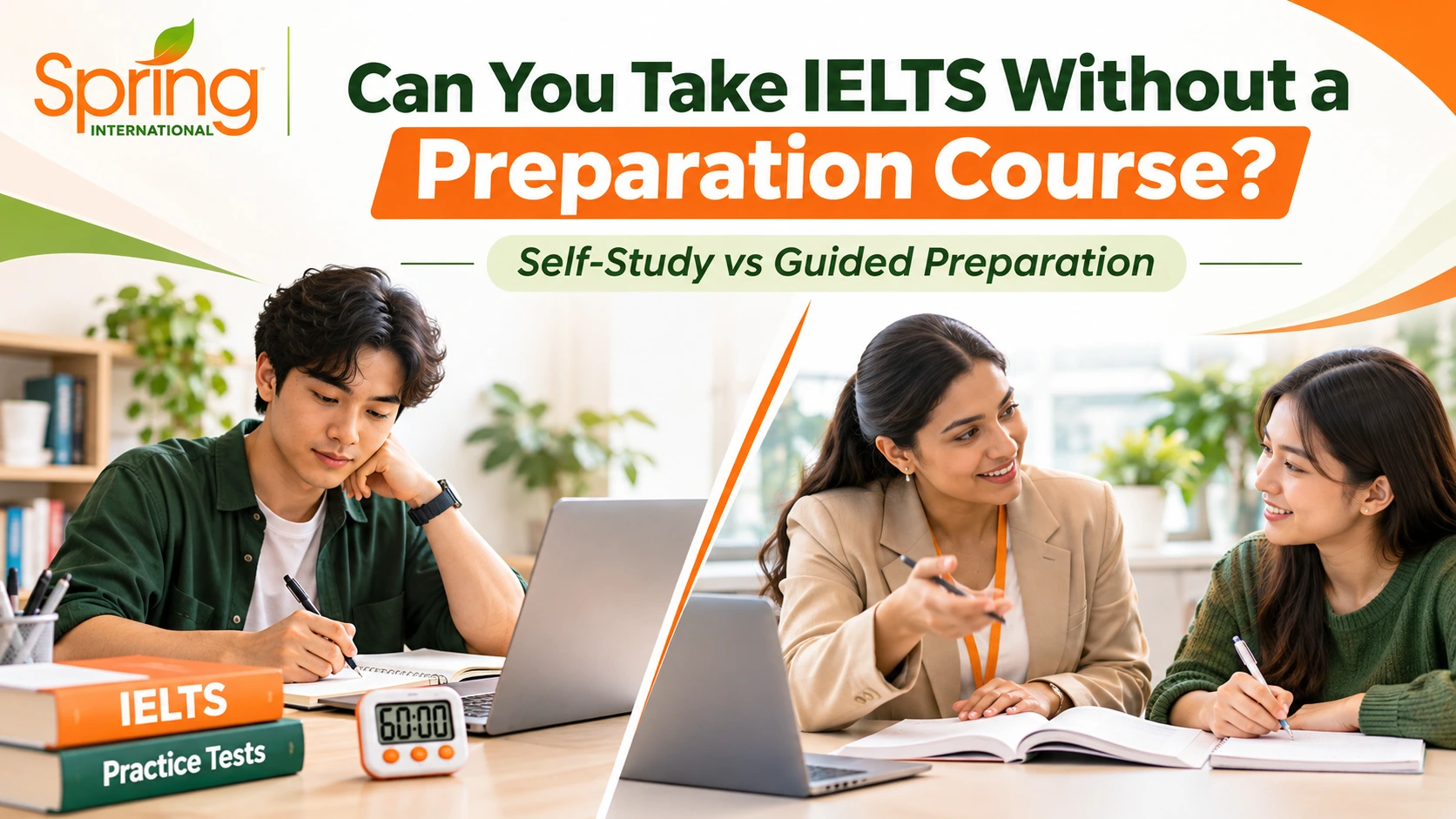
You can register and sit IELTS without attending any preparation course — IDP, British Council, and Cambridge Assessment English do not require proof of study or enrolment from any institution. That said, self-study reliably works only if your current level is already within 0.5 band of your target and you know exactly what the examiners are looking for. If you need to improve by a full band or more, or if you are unsure how your writing and speaking are being assessed, a structured course is usually the faster and more consistent path.
This article explains when self-study is sufficient, when it is not, what you need to prepare effectively on your own, and how to decide which approach fits you. All registration rules and band descriptors are set by the official IELTS partners.
Does IELTS require you to take a course first?
No — there is no mandatory preparation or enrolment requirement. You do not need to be enrolled at any school, college, or centre to book and sit the exam.
Requirement | Is It Mandatory? |
Valid passport / ID | ✅ Yes — mandatory |
Registration fee | ✅ Yes — mandatory |
Attendance at a preparation course | ❌ No — entirely optional |
Proof of current English level | ❌ No — not required to register |
Previous exam results | ❌ No — not required to register |
You can book directly through IDP or British Council once you have your identification and fee. That said, being allowed to sit the exam is different from being ready to pass it — many candidates book too early and receive the same score repeatedly.
When does self-study actually work?
Self-study is sufficient only when all of these apply:
- Your most recent mock test score is within 0.5 of your target band across all four components
- You understand the band descriptors clearly and can identify your own consistent errors
- You have reliable, timed practice materials that match the current exam format
- You can get feedback on your Writing and Speaking from someone who knows the marking criteria
- You study consistently — at least 30–60 minutes daily — until test day
If you are missing any of these, self-study usually leads to plateauing — most commonly at Band 6.5. If your foundations need strengthening first, begin with the Certificate in English before exam-focused practice.
When should you take a preparation course instead?
A structured course is strongly recommended in these situations:
Your Situation | Why Self-Study Is Harder |
You need to improve by 1.0 band or more | Language proficiency, not just exam technique, needs building — this takes structured progression |
You do not know your current level | You cannot measure progress or set a realistic test date |
Writing or Speaking are your weak sections | These are hard to self-assess accurately — you will miss your own errors |
You have already taken it and stayed at the same band | Your study method is repeating habits, not fixing them — a fresh approach is needed |
You have a firm deadline (university intake, visa) | A course follows a proven timeline and reduces risk of delay |
You are unsure what examiners actually want | Official descriptors exist but are dense — a teacher interprets them clearly |
Our IELTS English course includes regular mock tests and individual feedback so you know exactly when you are ready — no guessing or premature booking.
What do you need to self-study effectively?
If you decide to prepare on your own, you need more than practice tests — you need the right materials and routine:
Essential resources:
- Official practice materials from IDP or British Council — older or unofficial materials may differ from the current format
- The official band descriptors — read them so you know exactly what “Band 7” means in each section
- A timer — every practice session must be timed; untimed practice does not build exam-ready pace
- A way to get Writing and Speaking assessed — this is the gap most self-studiers cannot fill reliably
Realistic timeline:
- Within 0.5 band → 4–6 weeks of daily focused practice
- Within 1.0 band → 8–12 weeks with structured weekly goals
- 5+ bands away → 6+ months; consider starting with general English foundations
If you are unsure where you stand, take a free placement assessment — we can tell you your current estimated level and whether self-study is realistic for your target date.
What are the risks of preparing alone?
The biggest risk is not knowing what you do not know — and paying to retake the exam repeatedly:
- Writing looks fine to you but scores low — you know what you meant to say; the examiner sees unclear structure or limited vocabulary
- Speaking flows but scores low — you are comfortable, but you may be repeating phrases, giving short answers, or not extending ideas
- You practise the wrong format — materials older than 2023 may not reflect current question styles or timing
- You book too early — without mock tests, you cannot tell when you are actually ready
- You plateau — doing more of the same without feedback keeps you at the same band
Retaking costs time and money — one well-timed attempt beats several rushed ones.
Can you combine self-study with some classes or feedback?
Yes — this is often the most effective middle path:
- Study Listening and Reading on your own using timed tests
- Submit Writing tasks for professional feedback — one essay reviewed weekly is enough to guide your improvement
- Do a Speaking practice session once every 1–2 weeks with a qualified teacher
- Take a full mock test under exam conditions before booking your official date
This approach is more affordable than full-time preparation while still avoiding the biggest self-study blind spots. Our team offers individual writing and speaking feedback sessions — contact us to arrange these separately.
How do you know when you are ready to book?
Do not guess — book only when you have:
- Two consecutive full mock tests under timed conditions at or above your target band
- Consistent scores across all four sections — no component falls 0.5 below
- Clear understanding of your recurring errors and how to fix them
- Confirmed that your practice materials match the current exam format
If you cannot tick all four, keep preparing. Booking prematurely delays your progress rather than speeding it up.
KEY TAKEAWAYS
- No course is mandatory — you can register and sit IELTS entirely on your own.
- Self-study works best when you are already within 0.5 band of your target and can assess your own work accurately.
- Writing and Speaking are the hardest to improve alone — feedback from someone who knows the criteria is almost always necessary.
- If you need to improve by a full band or more, start with general English foundations before exam practice.
- Mock tests under timed conditions are the only reliable way to know when you are ready — not calendar dates or feeling “prepared”.
- Repeated retakes without feedback are rarely helpful — change your approach if your score stays the same.
Frequently Asked Questions
Will I get a lower score if I don't take a course?
Can I use free online materials instead of buying books or joining a class?
Yes — but verify they are official or up-to-date. Unofficial materials may have incorrect answers, overly easy questions, or outdated formats. Stick to resources from IDP, British Council, or Cambridge English.
If I have studied English for years, do I still need to practise specifically for IELTS?
What if I have no one to check my writing or speaking?
Is it cheaper to self-study in the long run?
Can I prepare for Academic and then switch to General Training?
Closing
SCI’s IELTS English is designed to get you to your target band reliably — with regular mock tests, individual feedback on every writing task, and speaking practice sessions. If you need to build general English first, start with the Certificate in English course to create the strong foundation exam preparation relies on.
If you would like a free level assessment or honest advice on whether self-study is right for you, you may contact us directly or book a tour at either our Bishan or Jurong East campus. You may also apply online at any time to begin your preparation.