

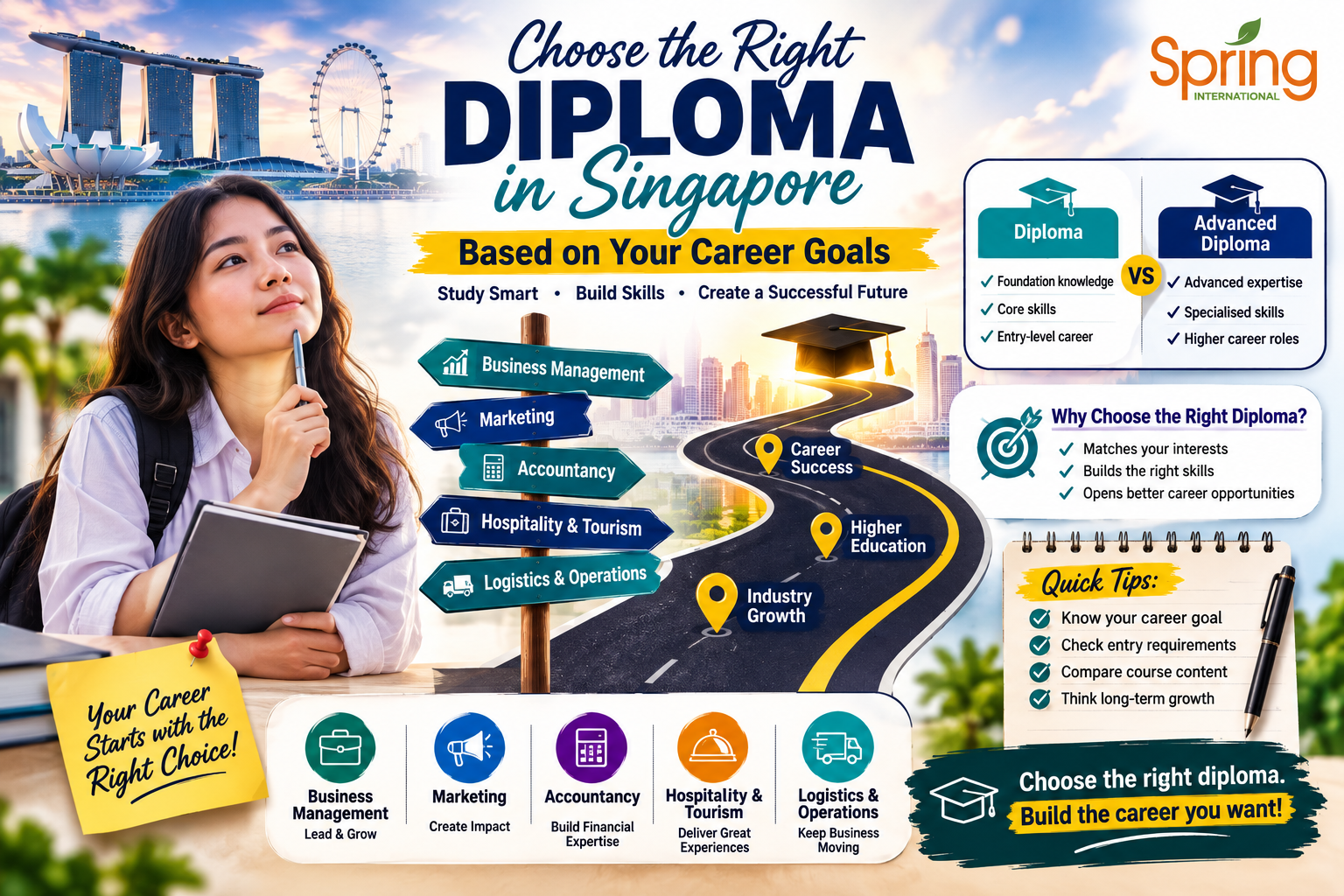
Choosing the right diploma in Singapore is an important decision, especially when you already have an idea of the career you want to pursue. The right programme can help you build relevant knowledge, develop practical skills and create a pathway towards further study or employment.
With different diploma options available, it is easy to focus only on course names or popularity. A better approach is to compare each programme based on your career interests, strengths, preferred work environment, study plans and long-term goals.
Spring College International offers career-focused Diploma and Advanced Diploma programmes in areas such as International Business Management, Marketing, Accountancy, Hospitality & Tourism Management, Logistics & Operations Management, Logistics & Supply Chain Management and Professional Chinese Teaching.
1. Start With the Career You Want to Build
Before selecting a diploma, think about the type of career or industry that interests you.
You do not need to know your exact future job title. Instead, consider the type of work you enjoy and the skills you would like to develop.
For example:
- Business and management → International Business Management
- Marketing, branding and digital media → Marketing
- Accounting and financial management → Accountancy
- Hotels, tourism and customer service → Hospitality & Tourism Management
- Operations, procurement and transportation → Logistics & Operations Management
- Supply chains and global logistics → Logistics & Supply Chain Management
- Chinese language education and teaching → Professional Chinese Teaching
The goal is not to find a single “best” diploma. It is to find a programme that is relevant to the direction you want to take.
2. Consider International Business Management for a Broad Business Foundation
If you are interested in how businesses operate across different functions and industries, International Business Management can provide a broad foundation.
The Diploma in International Business Management at Spring College International covers areas including business law and ethics, business statistics, international economics, organisational behaviour, accounting, information systems, management and marketing.
This type of programme can suit students who want to understand several areas of business rather than specialise in one narrow field.
Possible entry-level career directions include business associate or executive roles, marketing associate, operations coordinator, sales executive and administrative officer.
The programme also has a progression structure, allowing eligible students to continue from Diploma to Advanced Diploma.
3. Choose Marketing for Creative and Digital Career Interests
Marketing may be suitable if you enjoy communication, branding, customer behaviour, digital platforms and creative problem-solving.
Modern marketing combines traditional business knowledge with digital skills. Spring College International’s Diploma in Marketing includes Digital Marketing & Analytics and Customer Experience & Communications alongside business fundamentals.
Students interested in this area can develop knowledge relevant to marketing, communications, digital marketing, customer experience and related business roles.
When considering a Marketing Diploma, look beyond the course title and review the actual modules. A programme that includes both marketing fundamentals and digital components can provide a broader foundation for today’s business environment.
4. Consider Accountancy If You Prefer Numbers and Financial Work
Accountancy is a practical choice for students who enjoy working with numbers, financial information and structured processes.
Spring College International’s Diploma in Accountancy covers bookkeeping and accounting, cost accounting and business statistics, together with business subjects such as economics, information systems, management, marketing and business law.
This combination gives students an understanding of accounting while also introducing them to the wider business environment.
The Advanced Diploma builds on the foundation and incorporates LCCI Level 3 knowledge areas in Financial Accounting, Cost and Management Accounting, and Advanced Business Statistics.
If you are considering a future in accounting or finance, compare the accounting modules, progression options and professional development opportunities before choosing your programme.
5. Explore Hospitality & Tourism If You Enjoy People-Focused Work
Hospitality and tourism can be a good fit for students who enjoy customer interaction, service, hotels, tourism and fast-moving work environments.
The Diploma in Hospitality & Tourism Management covers areas related to hospitality operations, tourism, food and beverage, front office, housekeeping and other aspects of the industry.
An important consideration is practical exposure. Spring College International’s programme includes an industrial attachment structure, giving eligible students an opportunity to gain workplace experience as part of their studies.
When comparing hospitality programmes, consider not only the academic modules but also the practical training, course duration and progression opportunities available.
6. Consider Logistics for Operations and Supply Chain Interests
Logistics involves much more than transportation. It can include procurement, purchasing, warehousing, inventory, operations and the movement of goods through supply chains.
Students who enjoy planning, organisation and problem-solving may find this field interesting.
Spring College International offers both Logistics & Operations Management and Logistics & Supply Chain Management, allowing students to consider different areas within the wider logistics field.
Logistics & Operations Management can be relevant to students interested in areas such as purchasing, procurement, transportation, warehousing and operational processes.
Logistics & Supply Chain Management may be more suitable for students whose interests are focused on supply chain processes and global logistics.
Compare the programme structure and modules carefully to determine which pathway better matches your career goals.
7. Match the Programme With Your Strengths
Your career interest is important, but your natural strengths can also help you narrow down your choices.
Your Strength or Interest | Diploma to Consider |
Communication, leadership and business thinking | International Business Management |
Creativity, communication and digital interests | Marketing |
Mathematics, accuracy and financial thinking | Accountancy |
Customer service and people skills | Hospitality & Tourism Management |
Planning, organisation and problem-solving | Logistics & Operations Management |
Interest in supply chains and global trade | Logistics & Supply Chain Management |
Interest in Chinese language education | Professional Chinese Teaching |
This is only a starting point. Your strengths can overlap across different fields, so use the table to identify programmes worth researching further.
8. Think About Your Preferred Study Environment
The type of work you enjoy can also influence your decision.
If you prefer a business and office environment, International Business Management may be worth exploring.
If you prefer creative, communication and digital work, Marketing may be a better match.
If you enjoy structured financial work, consider Accountancy.
If you prefer customer-facing and service-oriented environments, Hospitality & Tourism Management may be suitable.
If you enjoy planning, coordination and operational processes, explore Logistics programmes.
Thinking about your preferred working environment can help you choose a programme based on more than just its title.
9. Consider Your Future Study Plans
A diploma can be an important qualification in its own right, but it can also form part of a longer education pathway.
Spring College International offers Diploma and Advanced Diploma programmes in several subject areas. For example, its International Business Management and Accountancy programmes have structured progression from Diploma to Advanced Diploma.
Before enrolling, ask:
- Can I progress to an Advanced Diploma?
- Does the programme support my longer-term career plans?
- Will I need another qualification later?
- Does the programme provide the foundation I need for my intended career?
Thinking about these questions early can help you avoid choosing a programme that does not fit your longer-term plans.
10. Decide Between Full-Time and Part-Time Study
Your personal circumstances should also influence your choice.
Spring College International offers selected Diploma programmes in both full-time and part-time formats.
For example, the International Business Management Diploma is listed as a 12-month programme for both full-time and part-time study, with different weekly lesson commitments.
Full-time study may suit students who want to focus primarily on their education, while part-time study can provide greater flexibility for eligible students balancing work or other commitments.
Always check the individual programme page for the latest study mode, schedule and duration because these can vary between programmes.
11. If You Are an International Student, Check the Requirements
International students should consider more than their preferred subject when selecting a diploma in Singapore.
Before applying, review:
- Academic entry requirements
- English-language requirements
- Course duration
- Full-time or part-time availability
- Student’s Pass requirements where applicable
- Future progression options
- Current programme fees and intake information
Spring College International’s current application information lists its available full-time and part-time diploma options and the applicable programme categories.
Always check the latest official course and admission information before submitting an application.
12. Compare Programmes Before Making Your Decision
Once you have identified two or three possible diplomas, compare them using the same criteria.
Career relevance
Does the programme match the industry or type of work you want to pursue?
Course modules
Do you find the subjects useful and interesting?
Practical learning
Does the programme include industrial attachment or other relevant practical exposure?
Study format
Does the full-time or part-time structure fit your circumstances?
Duration
Can you complete the programme within your preferred timeframe?
Progression
Is there an Advanced Diploma or another suitable next step?
Entry requirements
Do you meet the academic and English-language requirements?
Looking at these factors together gives you a clearer basis for making your decision.
Why Choose Spring College International?
Spring College International offers Diploma and Advanced Diploma programmes across several career-focused fields, including International Business Management, Marketing, Accountancy, Hospitality & Tourism Management, Logistics & Operations Management, Logistics & Supply Chain Management and Professional Chinese Teaching.
The college also provides selected programmes in full-time and part-time formats, giving eligible students different study options depending on their circumstances.
For students planning their education beyond the Diploma level, selected programmes also provide progression pathways to Advanced Diploma qualifications.
The best programme will ultimately depend on your academic background, interests, career direction and preferred way of studying.
Frequently Asked Questions
Which diploma is best in Singapore?
Which diploma is suitable for a business career?
Which diploma should I choose for digital marketing?
Which diploma is suitable for accounting and finance?
Which diploma is suitable for hospitality careers?
Which diploma is suitable for logistics?
Can I progress from a Diploma to an Advanced Diploma?
Final Thoughts
Choosing a diploma in Singapore is easier when you start with your career direction rather than simply looking for the most popular course.
Think about the type of work you enjoy, the skills you want to develop, the subjects that interest you and the qualification pathway you may want to follow in the future.
Whether your interests are in business, marketing, accountancy, hospitality, logistics or professional Chinese teaching, take time to compare the programme content, entry requirements, study mode, practical learning opportunities and progression options.
The right diploma should fit where you are today while supporting where you want your career to go next.