

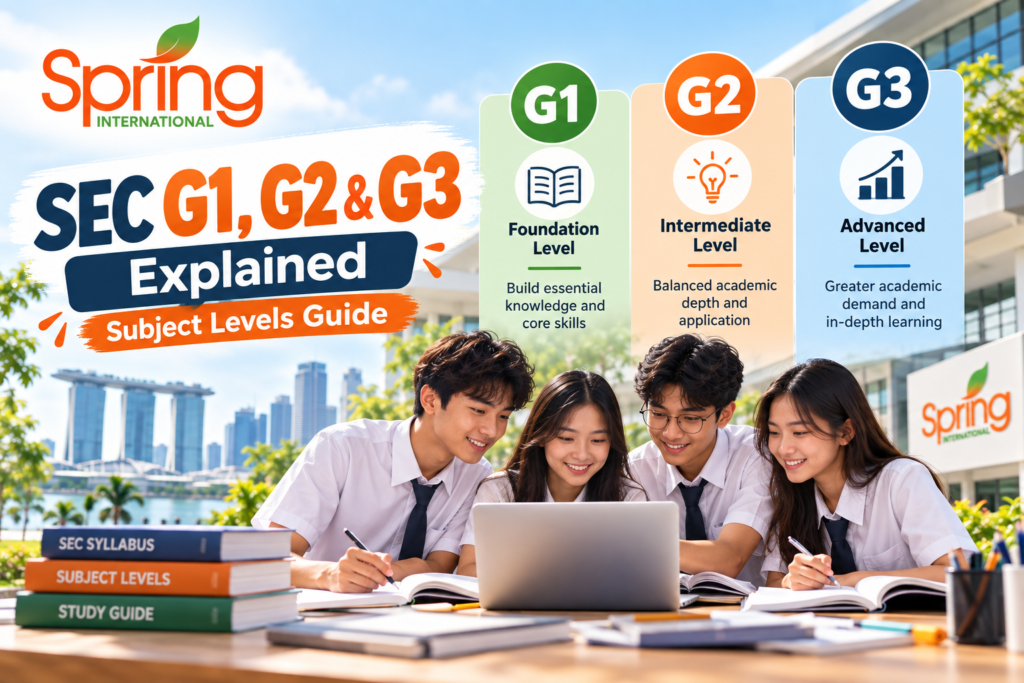
G1, G2 and G3 are three subject difficulty levels introduced under Singapore’s new Secondary Education Certification (SEC) framework, replacing the old O-Level standard and Higher subjects. G1 is the standard foundation level, G2 builds greater depth and application, and G3 is the advanced, most demanding level. Your choice affects secondary school progression, Junior College admission, and university eligibility — so you should select based on your ability and future goals.
This article explains what each level means, how they compare to the old system, how to choose, and how subject combinations affect your pathways. All SEC rules and subject levels are set by the Ministry of Education (MOE) and administered by the Singapore Examinations and Assessment Board (SEAB). Always confirm the latest subject lists and requirements directly with MOE or SEAB before registering.
What exactly are G1, G2 and G3?
The SEC replaces the GCE O-Level from 2027 onwards. Instead of the traditional “Standard” and “Higher” subject tiers, SEC introduces three levels — G1, G2, and G3 — representing increasing depth, complexity, and academic demand.
- G1 — Standard foundation level. Covers the core curriculum with emphasis on understanding and applying concepts. Comparable to former Standard subjects.
- G2 — Intermediate level. Covers more content and requires deeper analysis and problem-solving. Comparable to a middle tier between former Standard and Higher.
- G3 — Advanced level. Covers the most extensive syllabus, requires advanced reasoning, and is designed for students aiming for competitive university courses. Comparable to former Higher subjects.
Not every subject is available at all three levels. MOE publishes which subjects are offered at which level — English, for example, may be compulsory at a specific level, while Mathematics and Science may offer all three options. Students preparing for SEC 2027 and beyond can build their subject combinations through the Preparatory Course for GCE O-Level at SCI, which is being updated to align with SEC syllabi and subject levels as they are released.
How do the three levels compare side by side?
The table below summarises the key differences across the three tiers:
Feature | G1 | G2 | G3 |
Demand level | Standard / Foundation | Intermediate | Advanced / Higher |
Syllabus breadth | Core content | Extended content | Most extensive |
Cognitive demand | Understanding & application | Analysis & problem-solving | Reasoning, evaluation & synthesis |
Comparable to O-Level | Former Standard | New intermediate tier | Former Higher |
JC eligibility | May meet minimum entry | Meets most JC entry requirements | Preferred for competitive courses |
University readiness | Diploma / Polytechnic focus | Broad university eligibility | Competitive university pathways |
Recommended for | Stronger foundations first | Balanced progression | Academic strengths confirmed |
G3 is not universally “better” — it is simply more demanding. Taking G3 and performing poorly can be more disadvantageous than taking G2 and achieving a strong grade. Students should choose the level that matches their demonstrated ability and their intended next step.
Who should take G1?
G1 is the standard foundation level designed for students who need to build confidence and mastery before tackling more advanced content. G1 subjects cover the essential curriculum required to progress to Polytechnic, Institute of Technical Education (ITE), or selected post-secondary pathways. G1 satisfies minimum secondary education requirements, but may not meet the higher subject-level requirements for competitive Junior College courses.
Students starting at G1 typically progress by performing strongly — good grades at G1 can support upward adjustment to G2 or G3 in subsequent years, depending on school policy and MOE guidelines. If you are building English or academic foundations first, you may begin with the Certificate in English course to strengthen your language ability before committing to specific SEC subject levels.
Who should take G2?
G2 is the balanced, mainstream level suitable for most students. It offers solid academic rigour without the extreme volume and complexity of G3 syllabi. G2 subjects satisfy the standard entry requirements for most Junior College courses, all Polytechnic programmes, and most university pathways — both local and overseas.
Most students will take a combination of G2 subjects, possibly with one or two G3 subjects in areas of particular strength. G2 is generally the safest choice if you are unsure of your future pathway — it keeps all post-secondary options open without overloading your study schedule.
Who should take G3?
G3 is the advanced level designed for academically strong students aiming for competitive university courses — Medicine, Law, Engineering, Computer Science, and other high-demand programmes. G3 subjects include additional content, more advanced concepts, and higher-order assessment that aligns with Junior College and university expectations.
Taking G3 does not guarantee university admission — your grades still matter. However, competitive courses often require G3 passes in relevant subjects. Students should only take G3 if they have a strong track record in that subject and are prepared for the significantly increased workload. G3 is most valuable when planned early — speak with your school or preparatory programme about whether G3 is appropriate for your target pathway.
How do subject levels affect Junior College and Polytechnic entry?
Post-secondary institutions will set minimum subject-level requirements for admission. While exact criteria will be published by MOE and each institution, the general principle is: higher levels meet more requirements but are harder to pass.
- Polytechnic & ITE — Generally accept G2 and often G1 passes. Specific course requirements vary by programme.
- Junior College — Typically require G2 passes overall, with G3 passes preferred or required for competitive streams.
- University — Competitive courses may require specific G3 subjects at specific grades.
Your subject combination matters more than taking all G3. A sensible strategy is: G3 in your strongest 1–2 subjects relevant to your target course, G2 in everything else. This maximises eligibility without risking poor grades across your entire subject combination.
Can you change levels later?
Yes. One of the design intentions behind three levels is greater flexibility. Students can generally move up from G1 to G2, or from G2 to G3, if they demonstrate strong performance and the school approves. Moving down from G3 to G2 is also possible if the workload proves too heavy.
Level changes are subject to school approval, available places, and MOE guidelines. This means your choice is not permanently binding — but upward movement becomes harder the longer you wait. It is always easier to start at the right level than to adjust later. Monthly progress assessments at SCI help identify whether your current subject levels remain appropriate as you prepare.
KEY TAKEAWAYS
- G1 = standard foundation, G2 = balanced mainstream, G3 = advanced/higher tier under SEC from 2027.
- G2 satisfies most post-secondary entry requirements and is the safest balanced choice for most students.
- G3 is preferred for competitive university courses but carries significantly higher workload and difficulty.
- Subject levels should match your ability and target pathway — strong grades at G2 often outweigh weaker grades at G3.
- You can generally adjust levels later if performance warrants, but choose carefully from the start.
- Exact admission requirements for JC, Polytechnic, and university will be published by MOE and individual institutions — check official announcements.
Frequently Asked Questions
Will G3 subjects count for more in university admissions?
Can I take different subjects at different levels?
Is G3 the same as the old Higher O-Level?
What happens if I take G3 but fail or get a poor grade?
Are English and Mathematics compulsory at specific levels?
Do private candidates choose subject levels the same way?
Can I sit a subject at a higher level in a later year?
Closing
SCI’s Preparatory Course for GCE O-Level is being updated to align with SEC subject levels and syllabi as soon as MOE releases full specifications. Our academic team will advise you on which G1/G2/G3 levels match your strengths and intended pathway, so you choose the right combination from the start.
If you would like guidance on selecting subject levels or planning your SEC subject combination, you may contact us directly or book a tour to discuss your options in person. You may also apply online at any time to reserve a placement ahead of the transition to SEC.